
Blog
Digital Transformation in Nutrition: How POSHAN 2.0 Is Modernising Data Monitoring
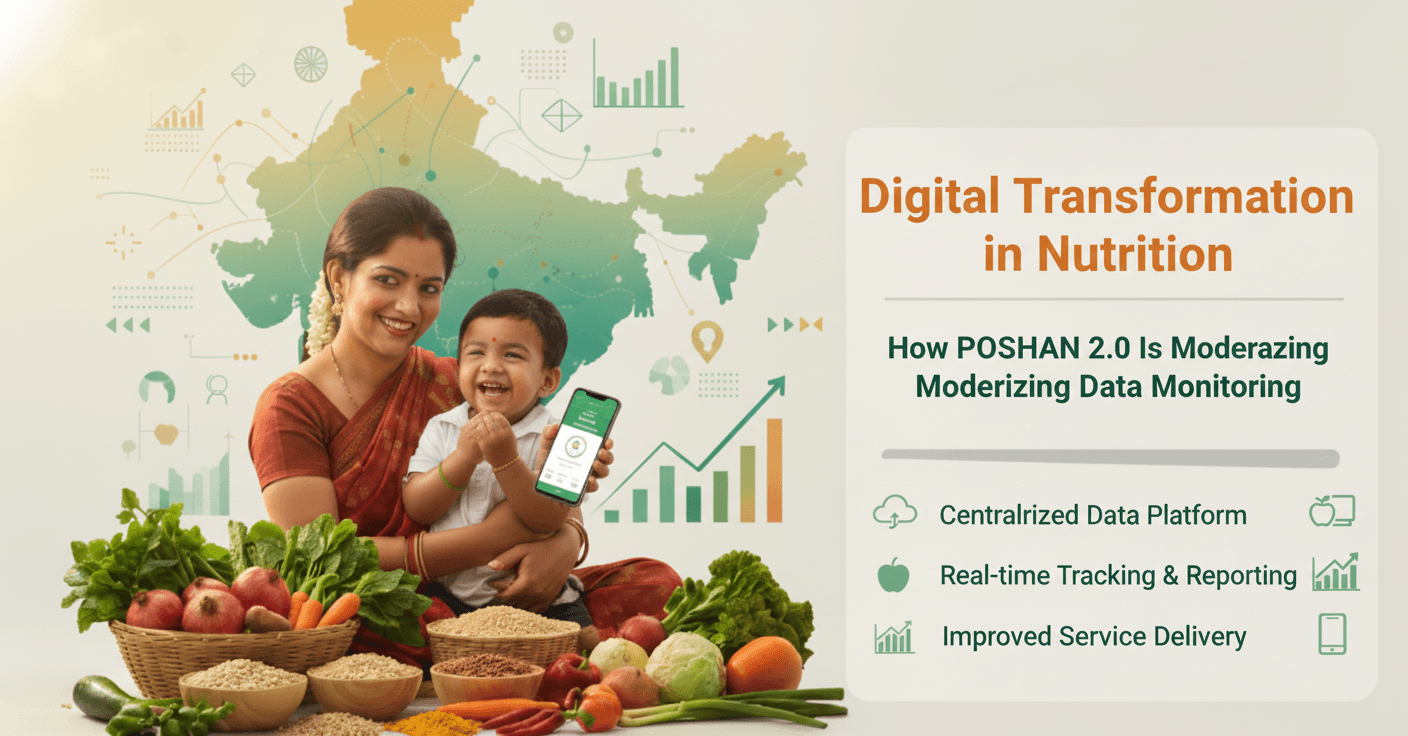
India’s nutrition challenge has never been just about food availability. It has always been about timely identification, accurate tracking, and coordinated action. For decades, nutrition programmes depended heavily on paper registers, delayed reports, and fragmented data flows. POSHAN 2.0 marks a decisive shift away from that model. By integrating technology into every layer of service delivery, the poshan 2.0 scheme is transforming how nutrition data is captured, monitored, and used. At the centre of this transformation is a robust approach to digital nutrition monitoring, supported by real-time dashboards, mobile-based reporting, and integrated data systems under ICDS. This article explains how POSHAN 2.0 is modernising nutrition data monitoring, what has changed on the ground, and why this shift matters for programme outcomes and governance.
Why Nutrition Programmes Needed Digital Transformation
Traditional nutrition monitoring systems faced multiple limitations:
- Delayed reporting from the field
- Manual errors in data compilation
- Limited visibility beyond block or district level
- Minimal use of data for decision-making
These gaps affected everything from fund allocation to early identification of malnutrition. Without reliable data, even well-funded programmes struggled to deliver results. The shift towards digital governance in health was not optional. It was necessary.
Understanding the POSHAN 2.0 Scheme
The poshan 2.0 scheme integrates nutrition-related components of ICDS into a unified framework that prioritises:
- Outcome-based monitoring
- Technology-enabled service delivery
- Transparency and accountability
- Data-driven decision-making
Unlike earlier approaches, POSHAN 2.0 does not treat data as a reporting requirement. It treats data as a core operational asset.
What Is Digital Nutrition Monitoring?
Digital nutrition monitoring refers to the use of technology to track, analyse, and act on nutrition-related data in real time. Under POSHAN 2.0, this includes:
- Mobile-based data entry at Anganwadi centres
- Automated growth tracking
- Real-time dashboards for supervisors and administrators
- Integrated reporting across ICDS and health systems
This approach replaces static, delayed reports with live insights.
POSHAN Tracker as a Nutrition Data Management System
At the operational level, POSHAN 2.0 is powered by a comprehensive nutrition data management system. This system enables:
- Beneficiary-level tracking
- Growth monitoring over time
- Service delivery documentation
- Consolidated reporting at block, district, and state levels
Instead of fragmented datasets, decision-makers now have a unified view of nutrition service delivery.
The Role of the POSHAN Tracker Dashboard
The poshan tracker dashboard is where data becomes actionable. It allows officials to:
- Monitor coverage and gaps in service delivery
- Identify high-risk geographies
- Track performance trends over time
- Take corrective action quickly
Dashboards reduce dependency on static monthly reports and enable faster, evidence-based decisions.
Strengthening ICDS Data Monitoring
Under POSHAN 2.0, icds data monitoring has become more structured and consistent. Key improvements include:
- Standardised indicators across states
- Reduced duplication of records
- Better validation through system checks
- Improved accountability at each administrative level
Supervisors and CDPOs can now focus on problem-solving rather than chasing reports.
Technology in Nutrition Programs: What Has Changed on the Ground
The introduction of technology in nutrition programs has changed day-to-day operations for frontline workers and administrators.
At the field level:
- Anganwadi Workers record services digitally
- Growth data is tracked longitudinally
- Follow-ups are easier to plan
At the administrative level:
- Data is available in near real time
- Performance comparisons are clearer
- Planning is based on trends, not assumptions
Technology has not replaced human effort. It has amplified it.
Improving Governance Through Digital Systems
One of the biggest outcomes of POSHAN 2.0 is improved digital governance in health. Digital systems enable:
- Transparency in service delivery
- Reduced scope for data manipulation
- Clear audit trails
- Better coordination between departments
When governance improves, trust in public programmes also improves.
Challenges in Digital Nutrition Monitoring
Despite progress, challenges remain:
- Device and connectivity issues in remote areas
- Learning curves for frontline workers
- Data quality inconsistencies during transition phases
These challenges highlight the need for continuous training, supportive supervision, and system refinement rather than rolling back digital initiatives.
Why POSHAN 2.0 Matters for Policy and Planning
The true value of POSHAN 2.0 lies in how data is used.
With reliable icds data monitoring, policymakers can:
- Identify priority districts
- Allocate resources more efficiently
- Measure programme impact over time
- Redesign interventions based on evidence
Data-driven systems reduce guesswork and improve accountability.
FAQs
Frequently Asked Questions (FAQs)
What is the main objective of the poshan 2.0 scheme?
To strengthen nutrition outcomes through integrated services and technology-enabled monitoring.
How does digital nutrition monitoring improve outcomes?
It enables early identification of risks and faster corrective action.
What is a nutrition data management system?
A digital system that captures, stores, and analyses nutrition-related data across levels.
What information is available on the poshan tracker dashboard?
Coverage, growth trends, service delivery data, and performance indicators.
How has icds data monitoring improved under POSHAN 2.0?
Through standardisation, real-time access, and reduced reporting delays.
Does technology increase workload for frontline workers?
Initially yes, but over time it reduces duplication and manual reporting.
Why is technology in nutrition programs important?
Because large-scale programmes need accurate, timely data to function effectively.
How does digital governance in health benefit beneficiaries?
It improves transparency, service consistency, and accountability.
What are the main challenges in digital nutrition monitoring?
Connectivity issues, training needs, and transition-related data gaps.
Is POSHAN 2.0 only about technology?
No. Technology supports the programme, but human effort and supervision remain essential.
Final Takeaway
POSHAN 2.0 represents a fundamental shift in how India approaches nutrition governance. By embedding digital nutrition monitoring into everyday operations, the programme has strengthened icds data monitoring, improved transparency, and enabled smarter decision-making. Technology alone will not solve malnutrition. But without strong digital systems, large-scale nutrition programmes cannot succeed. POSHAN 2.0 gets this balance right by combining field-level execution with modern data systems. As India continues to refine its nutrition strategy, the lessons from POSHAN 2.0 will shape the future of technology in nutrition programs and digital governance in health for years to come.