
Blog
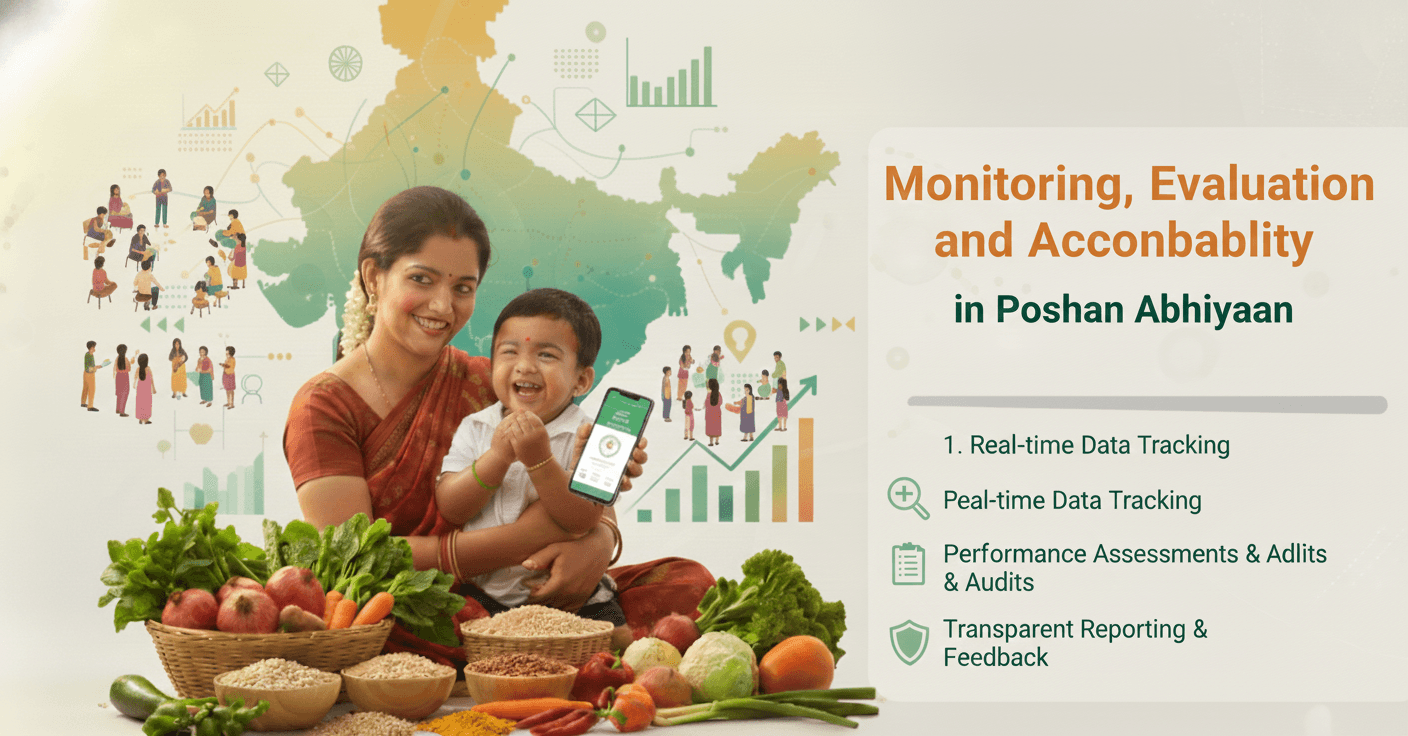
Monitoring, Evaluation, and Accountability in Poshan Abhiyaan
Large-scale nutrition programmes succeed not only because services are delivered, but because systems are in place to check whether those services are reaching the right people, at the right time, and with the right quality. Poshan Abhiyaan recognises this reality by placing strong emphasis on monitoring, evaluation, and accountability across all levels of implementation. Effective poshan abhiyan monitoring ensures that nutrition interventions move beyond paperwork and result in measurable outcomes. This article explains how monitoring and evaluation function under Poshan Abhiyaan, why accountability matters, and how data is used to improve nutrition governance in India.
Why Monitoring and Evaluation Matter in Nutrition Programmes
Nutrition outcomes change slowly and are influenced by many factors. Without strong monitoring and evaluation systems, it is difficult to know:
- Whether interventions are being delivered as planned
- Which areas are lagging behind
- What needs to be corrected or redesigned
Monitoring tracks performance in real time, while evaluation assesses effectiveness over a period of time. Together, they support evidence-based decision-making.
Understanding Poshan Abhiyan Monitoring
Poshan abhiyan monitoring involves the regular tracking of programme implementation at Anganwadi, block, district, and state levels. It focuses on:
- Coverage of nutrition services
- Quality of service delivery
- Timeliness of interventions
- Follow-up of high-risk beneficiaries
Monitoring is continuous and forms the first layer of accountability.
The ICDS Evaluation System: Moving Beyond Reporting
The icds evaluation system plays a critical role in understanding whether ICDS interventions are producing intended results. Evaluation under ICDS includes:
- Periodic programme assessments
- Outcome and impact evaluations
- Review of operational efficiency
- Identification of systemic bottlenecks
Unlike routine monitoring, evaluation looks at trends, outcomes, and long-term impact.
Nutrition Governance and Its Importance
Strong nutrition governance ensures that policies are translated into action and that responsibilities are clearly defined. Good governance includes:
- Clear roles across departments
- Transparent decision-making processes
- Data-backed planning and reviews
- Mechanisms for corrective action
Governance frameworks connect monitoring and evaluation to actual improvement.
Building an Accountability Framework under Poshan Abhiyaan
An effective accountability framework ensures that performance is reviewed fairly and constructively. Key elements include:
- Defined performance indicators
- Regular review mechanisms
- Supportive supervision rather than punitive action
- Clear escalation pathways for unresolved issues
Accountability works best when it strengthens systems instead of creating fear.
Data Verification in ICDS: Ensuring Data Quality
Data-driven systems are only as strong as the data they rely on. Data verification in ICDS is therefore essential. Verification mechanisms include:
- Cross-checking digital records with field observations
- Random sample verification during supervisory visits
- Review of outliers and inconsistencies
Accurate data supports better planning and credible evaluations.
Performance Review under Poshan Abhiyaan
Performance review under poshan is conducted at multiple levels. These reviews:
- Compare planned versus actual performance
- Identify high-performing and low-performing areas
- Guide capacity-building and resource allocation
When reviews focus on learning and improvement, they drive better outcomes.
Impact Assessment in Nutrition Programmes
While monitoring and reviews track progress, impact assessment in nutrition answers a deeper question: are nutrition outcomes actually improving? Impact assessments examine:
- Changes in stunting, wasting, and underweight prevalence
- Behavioural changes in communities
- Long-term effectiveness of interventions
These assessments inform future policy and programme design.
Role of Technology in Monitoring and Evaluation
Digital tools have strengthened monitoring and evaluation under Poshan Abhiyaan. They enable:
- Real-time data access
- Easier comparison across regions
- Faster identification of gaps
- More transparent reporting
Technology has reduced delays and improved visibility across the system.
Challenges in Monitoring and Accountability
Despite progress, challenges remain:
- Data quality inconsistencies
- Capacity gaps at supervisory levels
- Overemphasis on reporting compliance
Addressing these challenges requires ongoing training, system refinement, and leadership commitment.
What Makes Monitoring and Accountability Effective
Effective systems share common characteristics:
- Clear indicators linked to outcomes
- Regular, structured reviews
- Feedback loops from field to policy level
- Emphasis on improvement rather than punishment
When these elements are in place, accountability drives performance.
FAQs
Frequently Asked Questions (FAQs)
What is poshan abhiyan monitoring?
It is the continuous tracking of nutrition programme implementation and service delivery.
How does the icds evaluation system work?
It assesses programme effectiveness through periodic and outcome-based evaluations.
Why is nutrition governance important?
It ensures coordination, transparency, and accountability across departments.
What is an accountability framework?
A system that defines responsibilities, reviews performance, and supports corrective action.
Why is data verification in ICDS necessary?
To ensure decisions are based on accurate and reliable information.
How is performance review under poshan conducted?
Through regular review meetings and data analysis at multiple levels.
What is impact assessment in nutrition?
It measures long-term changes in nutrition outcomes due to interventions.
Does monitoring replace evaluation?
No. Monitoring and evaluation serve different but complementary purposes.
What role does technology play in accountability?
It improves data access, transparency, and timeliness.
What is the biggest challenge in nutrition monitoring?
Balancing data reporting with meaningful analysis and action.
Final Takeaway
Monitoring, evaluation, and accountability are not administrative formalities. They are the backbone of effective nutrition programmes. Strong poshan abhiyan monitoring, a responsive icds evaluation system, robust nutrition governance, and a fair accountability framework ensure that programmes remain focused on outcomes. When supported by reliable data verification in ICDS, regular performance review under poshan, and rigorous impact assessment in nutrition, Poshan Abhiyaan is better equipped to deliver real, lasting change. Good nutrition governance is not about control. It is about learning, improving, and delivering results that matter.