
Blog
Poshan Abhiyaan Explained: Goals, Strategic Pillars, and Impact on India’s Nutrition Landscape
Poshan Abhiyaan explained in detail—understand its goals, strategic pillars, implementation framework, and real impact on India’s nutrition landscape.

Malnutrition remains one of India’s most persistent development challenges, affecting children, adolescents, and women across socio-economic groups. To address this systematically, the Government of India launched Poshan Abhiyaan, a national mission that aims to improve nutritional outcomes through convergence, technology, and behavioural change. This article explains Poshan Abhiyaan in depth—its goals, strategic pillars, implementation design, achievements, gaps, and long-term impact on India’s nutrition landscape—using a skyscraper approach that goes beyond existing explanations and helps policymakers, practitioners, NGOs, and informed citizens make better decisions.
What Is Poshan Abhiyaan? A Clear Overview
Poshan Abhiyaan, also known as the National Nutrition Mission, is a flagship initiative that brings together multiple ministries, state governments, and frontline workers under a single nutrition-focused framework. Unlike earlier programmes that worked in silos, Poshan Abhiyaan focuses on convergence, outcomes, and accountability. The mission is implemented by the Ministry of Women and Child Development and aligns closely with existing schemes such as ICDS, NHM, and Swachh Bharat. Its core purpose is not just food distribution, but holistic nutrition improvement—addressing undernutrition, anaemia, low birth weight, and stunting through coordinated action.
Why Poshan Abhiyaan Was Needed in India
Despite decades of welfare programmes, India continued to report high levels of child stunting and wasting, widespread anaemia among women and adolescents, and significant intergenerational malnutrition. Fragmented delivery systems, limited use of data, and low community awareness reduced programme effectiveness. Poshan Abhiyaan was designed to fix these systemic issues by creating a mission-mode approach with measurable targets and real-time monitoring.
Core Goals of Poshan Abhiyaan
The goals of Poshan Abhiyaan are outcome-driven and time-bound, focusing on the most vulnerable populations. Primary nutrition targets include reducing stunting among children (0–6 years), reducing underweight prevalence, reducing wasting, reducing anaemia among women, adolescent girls, and young children, and improving birth weight outcomes. The population focus covers children, pregnant women, lactating mothers, and adolescent girls, positioning Poshan Abhiyaan as a life-cycle-based nutrition mission rather than a child-only programme.
Strategic pillars
The Strategic Pillars of Poshan Abhiyaan
4
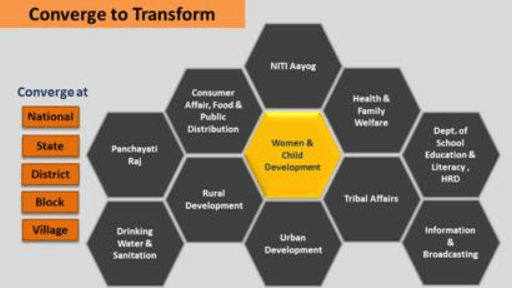
Convergence Across Ministries and Schemes
Nutrition outcomes depend on health, sanitation, education, and social protection. Poshan Abhiyaan integrates efforts across health services such as antenatal care and immunisation, ICDS and Anganwadi services, drinking water and sanitation initiatives, and food security programmes. This convergence ensures that beneficiaries receive complete nutrition support instead of fragmented services.
Technology and Data-Driven Governance
A defining feature of Poshan Abhiyaan is the use of digital tools, including real-time data collection by frontline workers, nutrition dashboards for monitoring progress, and evidence-based decision-making at district and state levels. This shift improves transparency, reduces leakages, and strengthens accountability.
Behaviour Change Communication (BCC)
Nutrition is not only about availability but also about awareness and practice. Poshan Abhiyaan invests heavily in community-level campaigns, promotion of breastfeeding and complementary feeding, and awareness around dietary diversity and hygiene. Behaviour change communication ensures sustainable nutrition gains by influencing household practices, especially among first-time mothers.
Capacity Building of Frontline Workers
Anganwadi workers, ASHAs, and ANMs are central to mission success. Poshan Abhiyaan strengthens training quality, supportive supervision, and incentives linked to outcomes. This improves service delivery and builds community trust.
Implementation Framework: How Poshan Abhiyaan Works on the Ground
Poshan Abhiyaan follows a bottom-up execution model where village and Anganwadi centres form the delivery base, district administrations coordinate convergence, states customise strategies based on local nutrition challenges, and central monitoring ensures standardisation and cross-learning. Nutrition months, Jan Andolan activities, and community events help translate policy intent into action.
Impact of Poshan Abhiyaan on India’s Nutrition Landscape
Key positive outcomes include improved monitoring and data visibility, stronger inter-ministerial coordination, increased community awareness around nutrition, and a sharper focus on outcomes rather than inputs. Several states have reported gradual improvements in nutrition indicators, particularly where governance capacity and frontline support are strong. Persisting challenges include uneven implementation across states, digital capacity gaps among frontline workers, socio-cultural barriers affecting behaviour change, and nutrition outcomes being influenced by poverty and food inflation.
How Poshan Abhiyaan Compares with Earlier Nutrition Programmes
Earlier programmes were largely scheme-based, with limited data use, weak convergence, moderate community focus, and input-driven accountability. Poshan Abhiyaan marks a shift to a mission-mode approach with real-time monitoring, convergence as a central pillar, strong behaviour change focus, and outcome-based accountability, making it a structural reform in India’s nutrition policy.
Role of Civil Society and Development Organisations
NGOs, CSR initiatives, and development partners support Poshan Abhiyaan by strengthening last-mile delivery, piloting innovative nutrition models, enhancing community engagement, and conducting independent evaluations. Organisations such as Bal Raksha Bharat contribute through advocacy, programme support, and grassroots implementation aligned with mission objectives.
Future of Poshan Abhiyaan: What Needs to Improve
To maximise long-term impact, Poshan Abhiyaan must strengthen state-level ownership, ensure continuous training and digital support for frontline workers, integrate nutrition goals with food systems and livelihoods, conduct independent outcome evaluations, and promote nutrition-sensitive agriculture and social protection. Sustained political priority and financing are critical for success.
FAQs
FAQs on: Poshan Abhiyaan Goals, Strategic Pillars, and Impact on India’s Nutrition Landscape
What makes Poshan Abhiyaan different from ICDS?
Poshan Abhiyaan strengthens ICDS through convergence, technology, and outcome monitoring rather than replacing it.
Who are the main beneficiaries of Poshan Abhiyaan?
Children under six, pregnant women, lactating mothers, and adolescent girls.
How does technology improve nutrition delivery?
Real-time data helps track growth, service delivery, and gaps, enabling faster corrective action.
Is Poshan Abhiyaan effective in rural India?
Yes, particularly where frontline workers are well-supported and convergence is strong, though challenges remain.
What role do Anganwadi workers play?
They deliver services, counsel families, and collect data, making them the backbone of implementation.
How does Poshan Abhiyaan address anaemia?
Through supplementation, diet counselling, health services, and behaviour change communication.
Can NGOs participate in Poshan Abhiyaan?
Yes, NGOs contribute to awareness, implementation, innovation, and monitoring.
What are the biggest gaps in Poshan Abhiyaan today?
Implementation disparities, digital readiness issues, and deeper socio-economic determinants of malnutrition.
Is Poshan Abhiyaan aligned with global nutrition goals?
Yes, it aligns with SDG 2 (Zero Hunger) and global maternal and child nutrition targets.
Conclusion: Why Poshan Abhiyaan Matters for India’s Future
Poshan Abhiyaan represents a strategic shift in how India approaches nutrition—moving from fragmented welfare delivery to a coordinated, data-driven, and people-centric mission. While challenges remain, its design addresses the root causes of earlier failures and provides a scalable framework for long-term impact. Strengthening implementation, convergence, and community trust will determine whether Poshan Abhiyaan can truly transform India’s nutrition landscape.