
Blog
Tackling Malnutrition in India: Effective Strategies under POSHAN 2.0
Malnutrition in India is not a hidden problem. It is visible in growth charts, school attendance, health outcomes, and productivity. Despite decades of interventions, undernutrition remains a major public health challenge, affecting children, women, and adolescents across regions and income groups. POSHAN 2.0 represents a renewed and more integrated response to this challenge. By strengthening service delivery, improving data systems, and focusing on outcomes rather than activities, the programme aims to accelerate child malnutrition reduction at scale. This article explains the reality of malnutrition in India, the strategic shift under POSHAN 2.0, and the most effective nutrition intervention strategies currently being implemented.
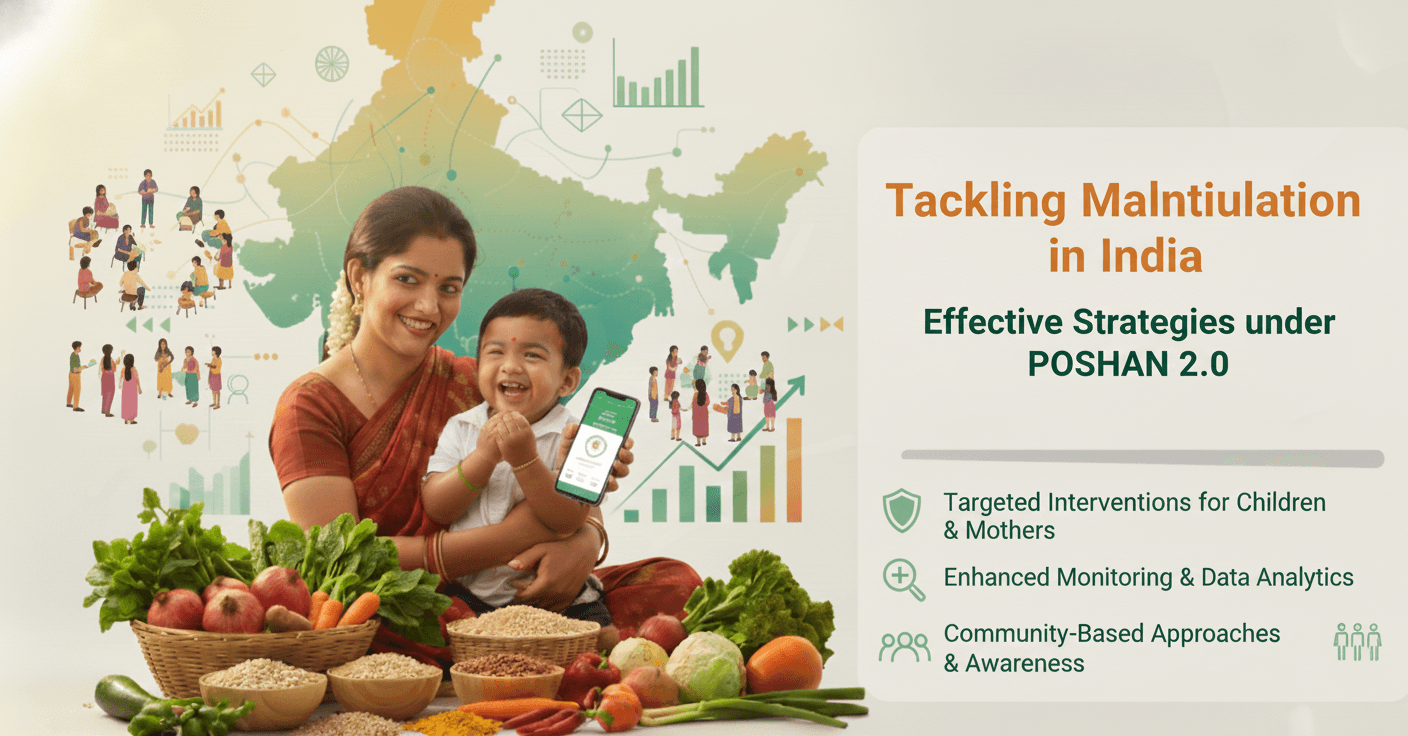
Understanding the Scale of Malnutrition in India
Malnutrition in India manifests in multiple forms:
- Stunting (low height for age)
- Wasting (low weight for height)
- Underweight
- Micronutrient deficiencies
These conditions are not only health issues. They affect learning ability, productivity, and long-term economic growth. Addressing them requires sustained, multi-layered action rather than isolated schemes.
From National Nutrition Mission to POSHAN 2.0
The national nutrition mission laid the foundation for a coordinated response to undernutrition. POSHAN 2.0 builds on this by integrating nutrition-related components of ICDS into a single framework that prioritises:
- Outcome-based monitoring
- Convergence across sectors
- Technology-enabled service delivery
- Community participation
This shift reflects a deeper understanding of what it takes to tackle malnutrition at scale.
POSHAN 2.0 Initiatives: What Has Changed
POSHAN 2.0 initiatives represent a move away from fragmented interventions toward a more holistic approach. Key changes include:
- Unified nutrition service delivery under ICDS
- Strengthened growth monitoring and follow-up
- Improved data collection and reporting systems
- Greater emphasis on behavioural change and counselling
The focus is no longer only on inputs, but on measurable outcomes.
Role of Government Nutrition Schemes
India’s nutrition response is supported by multiple government nutrition schemes working together. These include:
- ICDS services for early childhood care
- Supplementary nutrition for children and mothers
- Health services linked to nutrition outcomes
- School-based meal programmes
POSHAN 2.0 improves coordination between these schemes to reduce duplication and gaps.
Child Malnutrition Reduction through Early Intervention
Early childhood is the most critical window for intervention. Effective child malnutrition reduction strategies focus on:
- Timely growth monitoring
- Early identification of at-risk children
- Counselling caregivers on feeding practices
- Prompt referral to health facilities
Intervening early prevents long-term damage and reduces the need for intensive treatment later.
Stunting and Wasting Prevention: Targeted Approaches
Stunting and wasting prevention requires different but complementary strategies. For stunting:
- Focus on maternal nutrition
- Promote optimal infant and young child feeding
- Improve sanitation and hygiene
For wasting:
- Rapid identification through regular monitoring
- Medical management and referral
- Follow-up after recovery
POSHAN 2.0 emphasises both prevention and treatment.
Nutrition Intervention Strategies under POSHAN 2.0
Effective nutrition intervention strategies under POSHAN 2.0 include:
- Strengthened frontline service delivery
- Behaviour change communication at community level
- Convergence with health, sanitation, and education sectors
- Use of data to guide planning and supervision
These strategies recognise that nutrition outcomes depend on systems working together.
Technology and Data in Nutrition Governance
Technology plays a key role in improving programme effectiveness. Digital systems enable:
- Real-time tracking of growth and services
- Better supervision and accountability
- Evidence-based decision-making
Reliable data ensures that resources are directed where they are needed most.
Community Engagement as a Core Strategy
Sustainable nutrition improvement requires community ownership. POSHAN 2.0 supports:
- Nutrition awareness campaigns
- Community-based events
- Local leadership involvement
When families understand and value nutrition practices, outcomes improve naturally.
Challenges in Tackling Malnutrition
Despite progress, challenges remain:
- Regional disparities
- Capacity gaps at the frontline
- Behavioural and cultural barriers
- Infrastructure and connectivity issues
Recognising these challenges is essential for realistic planning and continuous improvement.
What Makes POSHAN 2.0 a Stronger Approach
POSHAN 2.0 stands out because it:
- Integrates services instead of isolating them
- Focuses on outcomes, not just activities
- Uses data for decision-making
- Emphasises capacity building and convergence
This makes it better suited to address the complexity of malnutrition in India.
FAQs
Frequently Asked Questions (FAQs)
What is malnutrition in India?
It refers to undernutrition, including stunting, wasting, and micronutrient deficiencies.
What are poshan 2.0 initiatives?
Integrated actions under ICDS to improve nutrition outcomes through better monitoring and service delivery.
How do government nutrition schemes work together?
Through convergence under POSHAN 2.0, reducing duplication and service gaps.
What is the goal of child malnutrition reduction?
To ensure healthy growth, development, and long-term well-being.
How is stunting and wasting prevention addressed?
Through early intervention, health integration, and targeted treatment.
What is the national nutrition mission?
India’s overarching framework to improve nutrition outcomes.
Why are nutrition intervention strategies important?
They guide how services are delivered and prioritised.
How does POSHAN 2.0 improve monitoring?
By using digital tools and real-time data systems.
Is community participation important in nutrition programmes?
Yes. Behaviour change and ownership are critical for success.
What is the biggest challenge in tackling malnutrition?
Ensuring consistent, high-quality implementation at the ground level.
Final Takeaway
Tackling malnutrition in India requires more than isolated schemes or short-term campaigns. It demands integrated planning, strong frontline systems, reliable data, and sustained community engagement. Through focused poshan 2.0 initiatives, aligned government nutrition schemes, and evidence-based nutrition intervention strategies, India is better positioned to achieve meaningful child malnutrition reduction and long-term stunting and wasting prevention. POSHAN 2.0 does not promise quick fixes. It offers a structured, realistic pathway to lasting nutrition outcomes.